

Planning a trip to Japan? Discover what destination management companies do, where to find them, and how to choose a local travel partner you can trust.
Japan is an extraordinary destination, but planning a trip that brings everything together can be more complicated than it first appears.
Imagine organizing a two-week journey through Tokyo, Kyoto, Kanazawa, Takayama, and Osaka. You may need local guides in different cities, transportation between destinations, suitable accommodation, and reservations for experiences that are difficult to arrange from overseas.
Then there are practical questions: How much can you realistically fit into one day? Will your preferred experience be available? Who coordinates the different services, and what happens if something changes?
For international travelers, these details can make the difference between an enjoyable journey and a stressful one. For overseas travel agencies, they represent another challenge: finding dependable local partners who can turn a proposed itinerary into arrangements that work in practice.
That is where a Destination Management Company (DMC) can help.
As Japan continues to attract record numbers of international visitors, knowing how to find a reliable local travel partner is increasingly valuable. According to the Japan National Tourism Organization (JNTO), Japan welcomed approximately 42.7 million international visitors in 2025, a record for the country.
Whether you are planning your own vacation or arranging a journey for clients, this guide explains what a DMC is, how to find one in Japan, what to look for before making a booking, and five companies worth exploring.
What Is a Destination Management Company (DMC)?
A Destination Management Company, commonly called a DMC, is a business that specializes in organizing travel experiences and services within a particular destination.
According to the Association of Destination Management Executives International (ADMEI), a DMC is a professional services company with local expertise and resources that can support activities, tours, transportation, events, and program logistics.
Put simply, a DMC is a local travel specialist who helps bring different parts of a trip together.
Rather than researching every supplier individually, travelers and travel professionals can work with a destination-based company that understands the local environment and can coordinate appropriate services.
Depending on the company and its capabilities, these services may include:
- Private sightseeing tours and local tour guides.
- Customized itineraries across several cities.
- Private vehicles and transportation arrangements.
- Cruise shore excursions planned around port calls.
- Cultural activities and specialized experiences.
- Accommodation and restaurant coordination.
- Corporate travel, incentive trips, and private group events.
- Local operational assistance for confirmed travel arrangements.
Not every DMC offers every service. Some specialize in large corporate groups, while others focus on particular regions, transportation, cultural experiences, or customized private travel.
Understanding those differences is the first step toward choosing the right partner.
How Is a DMC Different From a Travel Agent or Tour Operator?
The terms travel agent, tour operator, and DMC are sometimes used interchangeably, but their functions are not necessarily the same.
| Type of Business | Typical Role |
| Travel Agent or Travel Advisor | Helps clients plan and purchase travel services, often coordinating flights, accommodation, insurance, and complete travel itineraries. |
| Tour Operator | Develops, packages, and sells tours or travel experiences, sometimes combining multiple services. |
| Destination Management Company (DMC) | Uses local destination knowledge, supplier relationships, and operational resources to arrange and coordinate services within the destination. |
| Tour Guide | Accompanies travelers and provides guiding, interpretation, local knowledge, and assistance during a particular experience or tour. |
These roles frequently overlap. A DMC may also operate tours, sell directly to travelers, and collaborate with overseas travel advisors.
For example, a travel agent in Canada might help a family plan their Japan vacation. The agent could then work with a Japan-based DMC to arrange private guides, transportation, and local experiences. The DMC coordinates the agreed Japan-side services, while the travel agent manages the overall relationship with the family.
Alternatively, the family may contact a Japan-based operator directly.
Neither approach is automatically better. The right choice depends on how much planning support you need, which services are involved, and how you prefer to manage your trip.
When Should You Consider Working With a DMC in Japan?
Not every trip requires a destination management company.
If you only need a straightforward sightseeing tour in Tokyo or Kyoto, booking an established local experience may be sufficient.
A DMC becomes particularly valuable when your plans involve customization, specialized arrangements, or several services that need to work together.
1. You’re Planning a Multi-City Journey
Traveling across Japan can involve different transportation systems, local providers, and travel times.
An itinerary that looks convenient on a map may be less practical once transfers, luggage, accessibility requirements, and sightseeing time are considered.
A knowledgeable local partner can help evaluate the route and coordinate suitable arrangements across destinations.
For example, Japan Awaits offers custom multi-day tours in Japan for travelers looking to connect several destinations, private tour days, transportation, and other agreed travel services into one coordinated itinerary.
2. You Want a Personalized Day in One Destination
You don’t necessarily need a multi-day trip to benefit from local expertise.
Perhaps you have one free day in Kyoto, want to explore Tokyo beyond its most famous landmarks, or have specific interests that don’t fit a standard group tour.
A private guide can help shape the day around your preferred pace, interests, and available time.
For this type of travel, a custom single-day tour may be more appropriate than a full destination-management package.
3. You’re Visiting Japan on a Cruise
Cruise shore excursions require particular attention to timing and logistics.
Unlike a conventional sightseeing day, your available time is determined by your ship’s port schedule. Local transportation, port access, meeting points, and the time required to return to the vessel all need to be considered.
A port may also be some distance from the attractions travelers hope to visit.
An experienced local operator should review the realistic time available ashore and allow an appropriate return buffer rather than simply fitting as many attractions as possible into the itinerary.
Japan Awaits offers dedicated private cruise shore excursions in Japan, planned around the ship’s schedule, local conditions, and the traveler’s preferences.
4. You Need Private Transportation
Sometimes travelers have already decided where they want to go and simply need transportation that suits their group.
This may be particularly useful for families, larger groups, travelers carrying luggage, or those visiting locations that are inconvenient to reach by public transportation.
In such cases, arranging a private vehicle with a professional driver may be more suitable than booking a fully guided tour.
Japan Awaits’ private vehicle charter service is designed for travelers who primarily need transportation, with guiding services available separately where appropriate.
5. You’re Organizing a Corporate Trip or Special Event
Corporate incentives, educational visits, company excursions, and private group events can involve significantly more coordination than conventional sightseeing.
The organizer may need transportation for a large group, suitable venues, interpreters, specialist visits, activities, and a schedule that accommodates multiple participants.
These arrangements often benefit from a local partner who understands the operational requirements and can help coordinate the different elements.
For example, Japan Awaits’ custom events service is intended for businesses, organizations, and private groups seeking tailored experiences and event arrangements in Japan.
6. You’re a Travel Agency Seeking a Japan-Based Partner
Overseas travel agencies often need local specialists who can review itinerary requests, prepare quotations, arrange services, and coordinate the agreed program.
The right DMC can become a valuable long-term partner, particularly for agencies handling customized trips or repeat business to Japan.
How to Find a Reliable DMC in Japan
There are several ways to begin your search, but it is best to combine reputable directories with your own research.
Start With the Japan National Tourism Organization (JNTO)
The Japan National Tourism Organization is Japan’s official tourism promotion organization and provides resources for travel professionals and international visitors.
One useful starting point is its DMC directory, published on JNTO’s website.
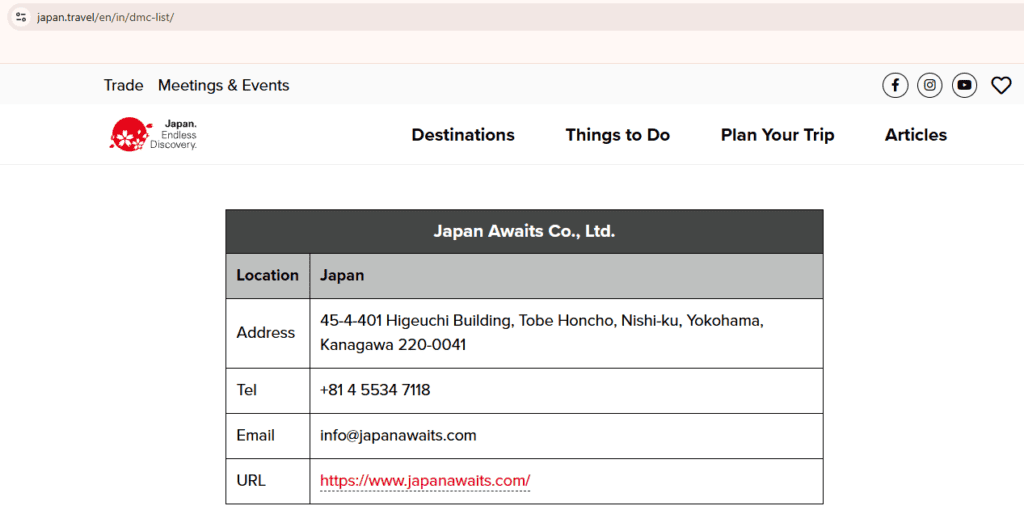
As of October 2026, the directory contained 38 named listings, based on a review of the published entries.
These include major Japanese travel companies, specialized tour operators, and Japan-based destination management businesses, including Japan Awaits.
The directory is particularly relevant to operators working with Indian leisure and MICE groups. It has specific listing conditions and should not be treated as an exhaustive register of every DMC operating in Japan.
For travelers and travel agencies from other markets, however, it can still provide a useful starting point for identifying companies and researching their services.
Important: Inclusion in a directory does not replace your own due diligence. JNTO does not guarantee the completeness or suitability of the information provided in this directory.
Explore JNTO’s Meetings and Events Supplier Directory
If your request involves corporate meetings, incentive trips, conferences, or large-scale events, another useful resource is JNTO’s Japan Meetings & Events Supplier Search.
This directory includes destination management companies and professional conference organizers.
It may be particularly helpful for businesses planning events or group programs that require specialist operational support.
Check Professional Organizations and Company Credentials
The Japan Association of Travel Agents (JATA) provides information about member travel companies.
Japan’s Tourism Agency also publishes information about the registration system under the country’s Travel Agency Act.
When considering a company, you should verify that it holds the registration or authorization appropriate to the services it provides.
A company describing itself as a DMC is not, by itself, proof of a particular legal registration category.
Review the Company’s Own Website and Experience
Once you have identified a few potential partners, look beyond the homepage.
Check which destinations they cover, the types of trips they regularly arrange, their operating history, their service terms, and whether they provide relevant examples of their work.
A company specializing in major conferences may be an excellent choice for a corporate group, but not necessarily the best fit for a couple seeking personalized cultural experiences.
The goal is to find the right expertise for your specific trip, rather than simply choosing the largest or most recognizable company.
5 Japan DMCs and Travel Operators to Explore
Japan has a wide range of travel businesses, from large nationwide operators to specialists focused on particular regions or services.
The following five companies illustrate different approaches to destination management and travel coordination in Japan.
This is not a ranking or an independently tested list of the five best operators. The companies were selected to show different areas of specialization and help readers understand what to look for.
This article is published by Japan Awaits, which is included as the fifth company.
1. JTB Global Marketing & Travel — Large-Scale Inbound Travel and Corporate Programs
Specialties: Inbound group travel, meetings, incentive programs, events, and destination logistics.
JTB Global Marketing & Travel is part of the JTB Group and provides inbound travel services in Japan.
Its offerings include organized travel programs, accommodation, transportation, venue arrangements, and activities for international groups.
The company also has substantial experience supporting conferences, incentive trips, and corporate events that require coordination across multiple service providers.
Worth exploring if: You are arranging a large group, corporate incentive, conference, or other program requiring extensive logistical coordination.
2. Nippon Travel Agency — Established Inbound Travel and Group Arrangements
Specialties: Group travel, leisure programs, business travel, and MICE.
Nippon Travel Agency (NTA) is one of Japan’s longest-established travel companies, with a history dating back to 1905.
Its inbound travel operations began in 1961, and the company offers services for international visitors across leisure and business travel.
NTA’s range of services includes group tours, individual travel arrangements, and meetings and events.
Worth exploring if: You value an established organization with broad experience arranging inbound programs, particularly for groups or corporate travel.
3. Heisei Enterprise — Transportation and Group Travel Logistics
Specialties: Chartered buses, transportation services, sightseeing tours, and group travel.
Heisei Enterprise operates travel and transportation services in Japan, including chartered buses, sightseeing transportation, and group travel arrangements.
Transportation can be one of the most important components of an organized Japan itinerary, particularly when a group needs to travel together or visit locations that are less convenient to reach using public transportation.
An operator with extensive transportation resources can be worth investigating when vehicle arrangements are central to a trip.
Worth exploring if: You are organizing group sightseeing, chartered transportation, or an itinerary where coordinated vehicle logistics are especially important.
4. Setouchi DMC — Regional Expertise Around Japan’s Inland Sea
Specialties: Setouchi regional travel, local culture, gastronomy, and destination-specific experiences.
Setouchi DMC focuses on the Setouchi region surrounding Japan’s Inland Sea.
This region spans seven prefectures and is known for historic towns, island scenery, art, traditional crafts, and distinctive regional food.
Setouchi DMC develops travel proposals and arrangements using its regional destination knowledge.
It illustrates an important point: when your itinerary concentrates on a particular part of Japan, a regional specialist may offer valuable insight into local experiences and travel possibilities.
Worth exploring if: Your trip focuses on the Seto Inland Sea region and you want to explore its local culture, food, landscapes, and lesser-known destinations.
5. Japan Awaits — Customized Tours and Nationwide Japan Travel Coordination
Specialties: Private tours, customized multi-day journeys, cruise shore excursions, local guides, private transportation, cultural experiences, and custom events.
Japan Awaits is a Japan-based travel operator established in 2016, with approximately a decade of experience helping international travelers explore Japan.
The company focuses on private and customized travel experiences, with services ranging from individual sightseeing days to more complex multi-city itineraries and private group arrangements.
Japan Awaits reports a network of 500+ licensed tour guides, together with local experts and travel partners supporting arrangements across Japan.
Its services include personalized single-day tours, custom multi-day travel, cruise shore excursions, private vehicle services, cultural experiences, and tailored events.
Its Japan-based team reviews requests for practical routing, timing, local availability, and operational feasibility.
For overseas travel agencies, Japan Awaits also offers a partnership program with structured request handling and eligible benefits for approved partners, including expedited quotation support and potential consultation-fee waivers.
Japan Awaits is also included in JNTO’s published DMC directory.
Worth exploring if: You are an independent traveler, family, private group, corporate organizer, cruise passenger, or overseas travel agency seeking flexible customized experiences and Japan-based coordination.
What Makes a Good DMC? 7 Things to Check
Finding a company is only the first step. Choosing one requires a closer look at its experience, operating practices, and ability to meet your particular needs.
Here are seven factors worth evaluating.
1. Relevant Experience and a Proven Track Record
How long has the company been operating, and what types of travel does it regularly handle?
A business with 10 or more years of experience may have developed valuable supplier relationships, practical destination knowledge, and experience responding to different operational challenges.
Japan’s travel industry is affected by seasonal demand, regional differences, transportation schedules, supplier availability, and changing visitor expectations.
Experience can matter when an itinerary requires several arrangements to work together.
However, longevity alone does not guarantee quality. A newer company with knowledgeable staff and strong operational processes may also be a suitable partner.
Ask for evidence of experience with trips similar to yours, not simply the company’s founding date.
2. Appropriate Registration and Transparent Business Information
A reliable company should be willing to explain its legal business identity, the scope of services it provides, and the applicable registration details.
In Japan, travel agencies and travel-service-arrangement businesses are subject to different registration requirements under the Travel Agency Act.
The relevant category depends on the activities the company performs.
You can review the Japan Tourism Agency’s explanation of travel business registration to understand the regulatory framework.
For business-to-business relationships, also ask about payment conditions, cancellation terms, supplier responsibilities, and any insurance or operational safeguards relevant to the proposed services.
3. Genuine Local Knowledge
Anyone can create an attractive-looking itinerary.
The more important question is whether it can actually be delivered.
A knowledgeable Japan-based operator should be able to explain why a proposed route is practical, whether a destination requires additional travel time, and which arrangements need advance planning.
For example, an itinerary involving several cities may require different local guides, transportation providers, and meeting arrangements.
A cruise shore excursion requires additional consideration of the ship’s schedule, port accessibility, and the realistic time available ashore.
Good local knowledge helps identify these requirements before they become problems.
4. Reliable Guide and Supplier Relationships
A DMC often depends on guides, transportation companies, venues, hotels, and local experience providers to deliver its services.
Ask how the company selects and coordinates these partners.
A large network can be an advantage, especially for itineraries covering multiple destinations. However, network size does not mean every service is available on every date.
A dependable operator should be transparent about availability and willing to explain suitable alternatives when the original request cannot be arranged.
5. Clear and Detailed Quotations
A good quotation should help you understand exactly what you are purchasing.
Look for information about included services, exclusions, duration, transportation, guide arrangements, optional costs, cancellation conditions, and items that remain subject to availability.
Comparing only the total price can be misleading.
One quotation may include a private vehicle and professional driver, while another assumes public transportation. One may include entrance fees, while another leaves them to the traveler.
Compare the services being provided, not just the final amount.
6. Responsive Communication and Realistic Turnaround Times
How quickly does the company acknowledge an inquiry? How clearly does it explain additional information requirements? When can you expect a usable quotation?
These are especially important questions for overseas travel agencies working with clients who may be comparing several destinations or suppliers.
A fast response is valuable, but it should not come at the expense of accurate information.
The ideal partner responds promptly, clarifies uncertainties, and distinguishes preliminary proposals from confirmed arrangements.
7. Clear Responsibilities When Plans Change
Travel arrangements can be affected by weather, transportation disruptions, seasonal closures, and supplier availability.
Before booking, ask who will coordinate the affected arrangements and what support is included.
Does the company provide a Japan-based operational contact? How are guides and drivers informed of changes? Which arrangements are refundable or changeable?
A reliable DMC should have clear processes for handling issues within the scope of its agreed services, without promising that every disruption can be prevented.
Why Quotation Turnaround Matters for Customized Japan Trips
For overseas travel agencies, quotation preparation can involve more than simply obtaining a price from a local operator.
Consider a typical customized multi-day inquiry.
A traveler approaches an agency in their home country with a proposed itinerary. The agency reviews the request and contacts a Japan-based DMC or travel operator to investigate local services, routing, and costs.
The Japan-based partner develops a proposal and returns it to the agency. The agency then reviews the information, checks that it meets the client’s requirements, and prepares its own quotation.
From Japan Awaits’ research and understanding, this process can sometimes take approximately five to eight business days from the initial inquiry to the proposal reaching the traveler.
An illustrative breakdown might look like this:
| Stage | Illustrative Time |
| Japan-based operator reviews the request and prepares a quotation | 3–5 business days |
| Overseas travel agency reviews, adjusts, and presents the proposal | 2–3 business days |
| Total | 5–8 business days |
These figures are an example based on operational experience, not a published industry-wide average. Actual turnaround varies considerably depending on the company, itinerary complexity, and information provided.
For travel agencies, reducing unnecessary back-and-forth can help clients receive proposals sooner.
It is therefore worth asking a prospective DMC about its quotation process, including what information is needed upfront and whether expedited handling is available.
How Japan Awaits Supports Travel Agency Quotations
Japan Awaits’ travel agency partnership program is designed to make Japan-side inquiry handling more structured and efficient.
For eligible, complete requests from approved travel agency partners, Japan Awaits targets an initial quotation within 24 hours, subject to request suitability and normal Japanese business operations.
Other customized inquiries are generally targeted within two to three business days after all necessary information has been received, depending on complexity.
Expedited quotation handling is intended for requests that contain sufficient travel details and do not require extensive additional research or unusual supplier coordination. Requests received outside normal business operations, or requiring significant clarification or specialist arrangements, may take longer.
The timing refers to the Japan-side quotation process, rather than the time required for an overseas agency to prepare its own final proposal.
Importantly, an initial quotation is not the same as a confirmed booking. Guides, vehicles, venues, and other supplier-based services remain subject to availability and the applicable confirmation process.
For travel agencies handling regular Japan business, a clear quotation process can be just as important as the services themselves.
Questions to Ask Before Choosing a Japan DMC
Before requesting a detailed proposal, prepare a shortlist of two or three companies whose services appear suitable for your trip.
Then ask:
- Have you arranged trips similar to mine? Ask about comparable group sizes, destinations, travel styles, or special requirements.
- Which services do you arrange directly, and which involve other suppliers? Understand how the company coordinates the different parts of your trip.
- What information do you need to prepare an accurate quotation? Share dates, group size, destinations, priorities, budget, and essential requirements.
- How long will the quotation take? Ask whether the stated turnaround refers to an initial estimate or a fully developed proposal.
- What is included in the price? Confirm guide fees, transportation, admission costs, meals, accommodation, and any other relevant expenses.
- How are changes or disruptions handled? Understand the cancellation conditions and available operational assistance.
- Who will be my main contact? Clarify responsibilities before and during the confirmed travel arrangements.
- Can you provide relevant reviews or examples of previous work? Look for evidence that reflects the type of travel you are planning.
You do not necessarily need the longest list of services or the lowest price.
You need a company that understands your objectives, communicates clearly, and can coordinate the arrangements you actually require.
How to Choose the Right Travel Partner for Your Japan Trip
A good starting point is to define what matters most.
For a corporate event involving hundreds of participants, group-handling capacity and event logistics may be the main priorities.
For a regional cultural journey, specialist destination knowledge may be more important.
For a family planning several private tour days across Japan, flexibility, guide coordination, realistic itineraries, and clear communication may carry greater value.
For cruise passengers, the ability to plan around port logistics and ship departure times is especially important.
And for overseas travel agencies, an established Japan-based operator that can respond efficiently, explain local feasibility, and support ongoing business may be particularly useful.
There is no single DMC that is automatically the right choice for every traveler.
The best choice is the company whose capabilities match your itinerary, expectations, and preferred way of working.
Planning a Trip to Japan? Explore Your Custom Travel Options
Japan offers remarkable opportunities for cultural exploration, regional discovery, and personalized travel.
Working with an experienced local partner can help transform those possibilities into a practical itinerary, whether you need one guided day, private transportation, a cruise excursion, or an extended journey across several destinations.
If you’re exploring private or customized arrangements, Japan Awaits offers several options depending on the type of support you need.
Custom Single-Day Tours
Discover a destination at your own pace with a private tour tailored to your interests, preferred locations, and travel style.
Ideal for travelers who want a personalized sightseeing experience with a knowledgeable local guide.
Custom Cruise Shore Excursions
Make the most of your time ashore with a private excursion planned around your ship’s port call, available sightseeing time, and local transportation conditions.
Designed for cruise passengers who want to explore Japan while accounting for the practical requirements of returning to their ship.
Custom Multi-Day Tours
Explore multiple destinations with a customized itinerary built around your interests, preferred travel pace, and arrangements across Japan.
Suitable for families, private groups, and travelers seeking coordinated support for a longer journey.
Private Vehicle Charter
Travel with a professional driver and private vehicle suited to your group and transportation needs.
A practical option for travelers who prefer flexibility and convenience without necessarily requiring a fully guided sightseeing experience.
Custom Events & Group Experiences
Planning a corporate incentive, private celebration, company visit, or special group experience in Japan?
Explore customized event arrangements designed around your group’s objectives, size, preferred destinations, and requirements.
For Travel Agencies: Partner With a Japan-Based Operator
Are you an overseas travel advisor or agency seeking Japan-side support for your clients?
Japan Awaits works with travel agencies arranging customized tours, private transportation, specialized experiences, and other eligible ground arrangements across Japan.
Learn about the Japan Awaits Travel Agency Partnership Program, including structured quotation handling and additional benefits for approved partners.
Information reviewed as of October 2026. Company services, directory entries, registration details, and quotation conditions may change. This article provides general guidance and should not be interpreted as an endorsement, certification, or independent ranking of the companies mentioned.
About the publisher: Japan Awaits is a Japan-based travel operator and one of the companies featured in this guide.